Tuesday, November 13, 2007

BYC Lighthouse Cruise--a shake down


Bay Yacht Club hosted a cruise the Charlie Butt's Light House in Lydia Ann Channel Sat. Nov. 10, 2007. It was a great chance to try out some of the new systems.

I rigged up a bridle for the dingy out of old Stay-Set X genoa line. I cut it in half and knotted it 2/3rds the way down. It worked very well. It acted as it's own safety line and was easy to adjust underway. The dingy rode well even at hull speed in a good chop.

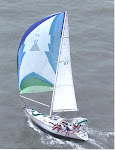
Sat. am was magnificent--clear, cool, and breezy. I set the new 130% roller-fulled genoa from Trent BcBride at Banks Sails. White Pepper just took off. The sail is beautiful and quite powerful--probably too much for CC Bay. I am sure it will be appreciated in the lighter breezes offshore and in the Chesapeake.

We got to the Light House just as lunch was being served. I threw out the new Rocna anchor and new shiny rode with 100' of chain. As advertised it bit hard within a few feet and stuck fast.

The afternoon was exquisite, the company good, the lighthouse wonderful as usual, but everybody left by 4 pm. Now it was time to change anchorages. I could not get the windless to engage. This was due to a failure to read the instructions--all 6 lines of them. The current was rippling and the sun going down fast. I had to lift the anchor and chain by hand which was no easy feat. It would have been impossible without Jan maneuvering the boat right over the anchor. I was determined not to stay in Lydia Ann all night. We set out for Mud Island with Jim and Jo Ann Robertson on Brigadoon.

Just after the sun set at 5;30 pm, I got the anchor down again and again it bit hard. I am starting to believe all the hype about the Rocna. By this time it was blowing hard, but we never moved an inch. Mud Island is one of the best anchorage in the area, but only available in a SE wind. I learned that I need a mid-ship cleat, maybe on the toe rail, to secure the dink for boarding.

The next morning we explored Mud Island by dingy and beach combed--something I had never been able to do without a dingy. The day was one of those amazing S. Texas winter days--sunny, cool and breezy--like San Diego is all year long. We did not get away until noon and had to creep home in the dark. At first the GPS guided us down the intracoastal waterway with survey like accuracy. Passing under the Kennedy Causeway bridge somehow gave the GPS a headache, and now it showed the ICW running across dry land. Worse still two of the large green day markers were not lit. It was a very tension filled last few miles. I was nauseated by the time we finally tied up at 9 pm. Jan bought a 3 million candle power 'Q-beam' flash light Monday morning. In this part of the world the 'Q-beam' in known as Cajun radar, and I will never sail without it.

We learned a lot and have more to learn, but the next time White Pepper leaves the slip it will be for good.

Wednesday, November 7, 2007

Tighten the toe rail

The only piece of advice the her previous owner, Mr. Horace Sylvester, gave me was to tighten the toe rail year yearly. He was very insistent on this point. I have followed the advice--but usually only before an offshore adventure. Before the Mexico trip in 2001 Desiree Trujillo and I spent a afternoon tightening all 200 of the 1/4-20 bolts that hold the deck to the hull. We found many loose, broken, or even missing bolts. It was a very rewarding day.

Today we covered the same ground. This time nothing was broken or missing. Each bolt usually required only a quarter or half turn. Some bolts near the center (widest) part of the boat needed a full turn or more. I broke two Phillips head #3 screw driver before I backed off to about 20 foot pounds of torque. It was tedious work and required patience of both the bolt turner (me) and the nut holder (Jan).

The chore seems odious but is so necessary. It keeps out the sea by squeezing the 5200 sealant between the deck and the hull. But it also adds potential energy to the boat. A quarter turn on 200 1/4-20 stainless steel bolt is equivalent to screwing in one bolt a full 5 inches. This is a tremendous gain in potential energy that can be translated into kinetic energy for sailing.

Thank you Jan and for everyone with a toe rail: tighten those bolts!

Tuesday, November 6, 2007

Habanero, our new dingy


Last week was devoted to bringing our new dink, Habanero, on board. Thursday, Nov. 1st, I drove to Houston, picked up Alan Dinn's truck at Harborwalk in Hiscock, (Thanks Alan!), picked up the new 130% genoa from Trent McBride, and finally went to Triad Marine to buy the dingy. It is a 10 foot AB made in Venezuela and we have had our eyes on it since last year. Bob and Kay Jack, ace cruisers, recommended it highly. It is a rigid inflatable with a deep vee to the bow. I seems stable and well built. Also I picked up the life raft at Triad where it had been it's annual check up. The fellows at Triad helped me lash the dingy into the truck. I drove slowly down the coast road finally getting home around 8:30 pm. It was a long, expensive, but very satisfying day.

Friday we went to Ronnie's Marine and bought a Yamaha two stroke 8 horsepower outboard. Saturday and Sunday was spent learning the combination of dink and outboard. The motor had to be broken in and well as the crew. However, after a lesion about opening the vent cap on the gasoline tank everything went very well. By Sunday Jan drove us to Soopy's via the ICW. Janet Freeman was visiting and was quite a trooper about everything.

Theft protection will be a 20 ft. length of 1/4 inch chain. We will lift the dink onto the foredeck with a block and tackle set on the spin pole. There is precisely 10 feet of space for it on the foredeck. The motor will ride on the stern rail where Jan has been varnishing a mount. We plan to test drive the whole system on a BYC cruise to the Port Aransas light house this weekend.

As an entomological note, habanero was a originally spelt Javanero. It is a spicy very small pepper originally from the Amazon basin. Later misspelling to habanero gave a suggestion of Cuban (Havana) origin which is not so. Americans will recognize habanero as the active ingredient in Tabasco sauce. Jan named the boat ,and I think its is a very clever play off of White Pepper. I wanted to name the dink Little Pepper or something equally banal.

Tuesday, October 30, 2007

Varnishing

Varnishing is an ancient art. There are accounts of pre-Roman expeditions through the Pillars of Hercules (the straits of Gibraltar) north to Umber (in Britain) to trade for amber. Amber is a key ingredient in varnish even today. The very word amber is derived from Umber. The composition of varnish remained unchanged for thousands of years until modern polyurethanes were added. The use, however, would be familiar to ancient Phoenician mariners--protect and beautify the wood.

For years I had used Cetol on the minimal amount of teak on the C&C. Cetol is a synthetic mix that is easy to apply, very durable, and looks good for a while. Eventually it takes on sickly orange color. It is the perfect product for the busy yacht racer.

Jan wanted something better for White Pepper--real varnish. She stripped off the thick, old Cetol and sanded it all down. Then she bleached off the mold with a two part teak cleaner and sanded again. Using plain old Z-spar varnish she has lovingly applied 7 coats to the exterior trim. With taping off the trim and sanding between each coat the project has taken weeks. Part of the delay has been weather as only the prettiest days are suitable for applying the varnish. She told me that Z-spar has a 'soft' finish will take some abuse. Also it is cheap and available in ship stores anywhere we might need a touch-up. New coats have to be applied every 6 months, and the whole thing has to be redone every three years.

Why go to so much work for only 8 pieces of exterior trim? The effect is exquisite. Seeing the natural teak grain glisten under a silky smooth finish just makes me happy to look at it. It just glows in the sunlight.

Hopefully, later I can post about the interior wood. There is much more wood inside. The care of it is oil based and just as important. However, it lacks the ancient mystique of varnish.

Thursday, October 11, 2007

Running lights

Hard work today. The running lights on the bow have been a problem since I bought the boat. The failure rate upon turning on the lights was so great that I adopted a regimen of turning on the lights 30 minutes before sunset so that if the lights did not turn on there would be 30 minutes of daylight to try to fix something. They are Aqua Signal 41 series which are well engineered and simple in the extreme. However, they are suspended out over the bow and often under water when beating to weather in moderate to heavy air. Then the wires run through the anchor well which is always wet. Over the years the wiring has evolved into a rat's nest. Recently the port light was broken. I replaced it, but the light would not come on because the wires were so corroded that the no amps could come though.

I resolved to bullet proof the fore peak. I got a junction box and bought the 12 volt to the junction box in the anchor well. Then I divided the 12 volt into 2 parts and sent it up each side of the anchor well through a 14 gauge duplex well secured with clamps just under the toe rail. For extra security I used heat shrink terminals all the way. The heat shrink spade in the lights themselves are each $2. But it is as water proof as I can make it.

The whole project took hours, but I am sure now that when I ask Jan to turn on the running lights they will go on and stay on.

Monday, October 8, 2007

New fan

I installed a new Guest 12 volt oscillating fan in the fore peak. When it's raining, the hatches are closed and stuffy, I am sure I will be grateful. But it was a hassle. It came with two small #6 screws. Jan pointed out that they would not last long with all of the pounding. I got two long #6 bolts and went through the bulkhead. The fan is not going anywhere. The fan draws 1.5 amps, but blows a hurricane.


The second reef line came today. 81 feet of 3/8" Warpspeed.

Wednesday, October 3, 2007

Ramses goes swimming

To take the cat or not; that is the question. Without a reasonable place to place Ramses we will try to acclimatize him to the boat. Jan bought an ultra small life jacket at Pet Smart. We put it on several times in the condo (see picture). Common knowledge, but previously unknown to me, is that tying something around a cat's abdomen ruins their equilibrium. The results are indeed comical. Now was the the time to try him on the boat. He was fine on the dock and inside the cabin. Then in the cockpit he made a run for the bow and freedom. That was aborted. Back in the cockpit all seemed well until two dogs started barking across the channel. He bolted for the port rail and a chance to jump to the finger pier. The life jacket was an encumbrance, and Ramses ended up in the drink. To his credit he came up swimming and fast towards the bulkhead. I was able to grab the handle on the back of the life jacket. Maybe Ramses touched the dock, but he seem to levitate six feet to the grass and then into the bushes. He did not come in until midnight. The next morning he spent several minutes examining the scene of the crime before retiring to his usual hang out under the ferns and bushes. Only time will tell if Ramses can adjust to the yacht.